
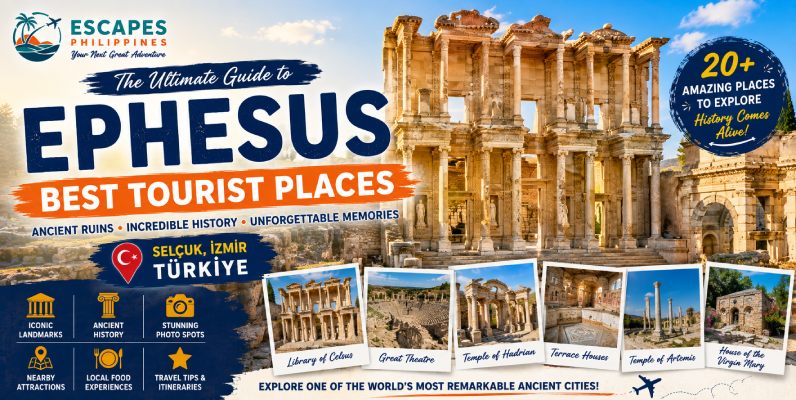
Looking for the Best Tourist Places in Ephesus? Step into one of the most remarkable ancient cities in Türkiye, where magnificent Roman ruins, marble streets, monumental temples, ancient theatres and centuries of religious history come together. Located near Selçuk in İzmir Province, Ephesus is one of the world’s most fascinating archaeological destinations and a must-visit for anyone interested in ancient civilizations, history, architecture and culture.
From the breathtaking Library of Celsus and enormous Great Theatre to the Terrace Houses, Temple of Hadrian, ancient commercial streets and the nearby House of the Virgin Mary, there are countless places to visit in Ephesus. Moreover, Ephesus can easily be combined with other spectacular destinations in western Türkiye, including Pamukkale and İzmir.
In this comprehensive guide, we’ll explore the Best Tourist Places in Ephesus, the most important ancient monuments, fascinating historical attractions, nearby places worth visiting, practical travel tips and itinerary ideas to help you make the most of your journey.
Why Visit Ephesus?
Ephesus isn’t simply a collection of ancient ruins.
It was once a major city of the ancient Mediterranean world, and its strategic location helped it become an important political, commercial, cultural and religious center.
UNESCO describes Ephesus as an exceptional example of a Roman port city and recognizes its outstanding archaeological remains, including the Library of Celsus, Great Theatre, Terrace Houses and other monumental structures. The property was inscribed on the UNESCO World Heritage List in 2015. Read the official UNESCO Ephesus World Heritage information.
Consequently, visiting Ephesus feels more like walking through an open-air history book than visiting a conventional tourist attraction.
Top Reasons to Visit Ephesus
- Explore one of Türkiye’s most important ancient cities
- See the spectacular Library of Celsus
- Walk along ancient marble streets
- Stand inside the enormous Great Theatre
- Explore beautifully preserved Roman Terrace Houses
- Discover the remains of the Temple of Hadrian
- Learn about the ancient city’s commercial life
- Explore early Christian heritage
- Visit the House of the Virgin Mary nearby
- Discover the ruins of the Temple of Artemis
- Visit the Basilica of St. John
- Explore the historic town of Selçuk
If you’re planning a wider international adventure, you can also explore the Destinations collection from Escapes Philippines for more travel inspiration.
Best Tourist Places in Ephesus You Should Not Miss
Ephesus is a large archaeological site with numerous monuments spread across an extensive area. Therefore, it’s worth planning your visit instead of simply arriving and wandering without knowing which attractions deserve the most attention.
Here are some of the Best Tourist Places in Ephesus that should be on your itinerary.
1. Library of Celsus
The Library of Celsus is undoubtedly one of the most recognizable landmarks in Ephesus.
Its magnificent two-story façade, decorated with columns, statues and elaborate architectural details, is one of the most photographed sights in the entire archaeological site.
The library was constructed during the Roman period in honor of Tiberius Julius Celsus Polemaeanus, a prominent Roman senator and governor of the province of Asia.
Although much of the original building has disappeared, the reconstructed façade provides an extraordinary impression of the architectural sophistication of ancient Ephesus.
UNESCO specifically identifies the Library of Celsus as one of the grand monuments of the Roman Imperial period that contributes to Ephesus’ Outstanding Universal Value.
Why Visit the Library of Celsus?
- One of Ephesus’ most iconic monuments
- Outstanding Roman architectural details
- Excellent photography opportunities
- Important connection to ancient scholarship
- One of the highlights of any Ephesus itinerary
Photography tip: Take time to photograph the façade from several angles rather than capturing only the standard front-facing view.
2. Great Theatre of Ephesus
The Great Theatre of Ephesus is another extraordinary monument.
Built into the slope of Mount Pion, this enormous theatre could accommodate a very large audience and played an important role in the social and cultural life of the ancient city.
As you stand inside the theatre and look across its enormous seating area, it becomes much easier to imagine the scale of ancient Ephesus.
The theatre also has strong historical connections to early Christianity. According to the biblical account in Acts, the theatre became associated with a major confrontation involving followers of the Christian faith and supporters of the city’s traditional religious practices.
What Makes the Great Theatre Special?
- Huge ancient seating area
- Impressive hillside location
- Exceptional panoramic views
- Important cultural and religious history
- One of the most dramatic structures in Ephesus
UNESCO lists the Great Theatre among the major Roman Imperial monuments that demonstrate the importance of ancient Ephesus.
3. Curetes Street
Curetes Street was one of the principal streets of ancient Ephesus.
Walking along this ancient thoroughfare is one of the best ways to understand how the city was organized.
The street connected important public and religious buildings and was lined with monuments, columns, shops and other structures.
Today, visitors can walk along sections of the ancient marble-paved street while observing the remains of buildings that once stood along its sides.
What to Look For Along Curetes Street
- Ancient marble paving
- Columns and architectural fragments
- Monumental fountains
- Temple remains
- Historic shops and public buildings
- Terrace Houses
- Roman-era inscriptions
Because several major attractions are located along or near Curetes Street, it naturally becomes one of the most important routes for visitors exploring Ephesus.
4. Terrace Houses of Ephesus
The Terrace Houses offer something very different from Ephesus’ monumental public buildings.
These beautifully decorated Roman residences provide insight into how wealthy people lived in ancient Ephesus.
Inside, visitors can see remnants of intricate mosaics, frescoes, marble decoration and architectural features that reveal the sophistication of elite Roman domestic life.
The official Turkish Ministry of Culture and Tourism describes the Terrace Houses as a group of Roman residences built on terraces along the slopes of Mount Koressos, with examples dating to the 1st century AD. See the official Terrace Houses information.
Why Are the Terrace Houses Worth Visiting?
- Beautiful ancient mosaics
- Colorful wall frescoes
- Insight into wealthy Roman lifestyles
- Detailed domestic architecture
- Excellent archaeological preservation
If you’re particularly interested in Roman history and ancient lifestyles, don’t skip this attraction.
5. Temple of Hadrian
The Temple of Hadrian is one of the most elegant surviving monuments along Curetes Street.
Its decorated façade, columns and arches showcase the refined architectural style of the Roman period.
The temple was dedicated to Emperor Hadrian and represents the close relationship between political power and religious architecture in the Roman world.
Although relatively small compared with the Great Theatre, the monument is exceptionally photogenic.
Best Reason to Visit
Visit the Temple of Hadrian for its detailed reliefs, graceful proportions and its position along one of the most beautiful sections of Curetes Street.
6. Temple of Domitian
The Temple of Domitian was associated with Emperor Domitian and was among the monumental structures of ancient Ephesus.
Its remains help demonstrate how imperial power was represented through architecture throughout the Roman Empire.
Although much of the temple has disappeared, the surviving foundations and architectural fragments provide an important glimpse into the city’s monumental center.
7. Hercules Gate
Hercules Gate is one of the most recognizable structures along Curetes Street.
The surviving columns and decorative elements once formed part of a monumental gateway that helped define the movement through the ancient city.
The gate is particularly popular with photographers because the remaining columns frame the street and surrounding ruins beautifully.
Photography Tip
Stand farther down Curetes Street and photograph the gate with the ancient road extending into the background. This creates a strong sense of depth.
8. Trajan’s Fountain
Trajan’s Fountain was a monumental fountain dedicated to Emperor Trajan.
Fountains played an important role in ancient cities, providing both practical water access and opportunities for monumental decoration.
The remains of the fountain help visitors understand how public spaces in Ephesus combined functionality with impressive architecture.
9. Scholastica Baths
The Scholastica Baths provide another fascinating glimpse into daily life in ancient Ephesus.
Roman bath complexes were much more than places for bathing. They were important social spaces where people could meet, relax and conduct conversations.
The remains of the complex demonstrate the importance of public bathing culture in Roman society.
Exploring the baths also helps put the city’s monumental streets into a more human context.
10. Latrines of Ephesus
While they may not sound like the most glamorous attraction, the ancient Latrines of Ephesus offer an unusually interesting insight into everyday Roman life.
The communal facilities were connected to the broader public infrastructure of the city and demonstrate how ancient urban communities managed sanitation and public spaces.
For travelers interested in archaeology, this small attraction can be surprisingly fascinating.
11. Odeon
The Odeon of Ephesus was a smaller performance and meeting venue compared with the enormous Great Theatre.
Its smaller scale suggests that it served different functions, including musical performances and civic gatherings.
The structure provides another example of the sophisticated public architecture that existed throughout ancient Ephesus.
12. State Agora
The State Agora was an important public area within ancient Ephesus.
Agoras served as central spaces for civic, commercial and social activities in ancient Greek and Roman cities.
Walking through the remains allows visitors to imagine the crowds, merchants, officials and citizens who once occupied these public spaces.
13. Commercial Agora
The Commercial Agora was closely connected to the economic life of Ephesus.
As a major ancient city and port, Ephesus depended heavily on trade.
Merchants and travelers from different parts of the Mediterranean would have passed through the city, making it a culturally diverse and economically important center.
The remains of the Commercial Agora provide a glimpse into this commercial side of ancient Ephesus.
14. Marble Street
Marble Street is one of the most impressive ancient roads in Ephesus.
Walking along its surviving sections gives visitors a powerful sense of how monumental the ancient city must have appeared to residents and travelers.
The road connected major parts of the city and formed part of the processional routes through Ephesus.
However, visitor access can change because of conservation and restoration work. The Turkish Ministry of Culture and Tourism currently notes restrictions affecting part of the route near the Library of Celsus, so check the official site information before visiting.
15. Gate of Mazeus and Mithridates
The Gate of Mazeus and Mithridates stands near the Library of Celsus and is another important architectural feature of ancient Ephesus.
The monumental gateway helped connect the library area with other parts of the city.
Its proximity to the Library of Celsus makes it easy to include in your sightseeing route.
16. Brothel of Ephesus
The structure traditionally identified as the Brothel of Ephesus provides an unusual perspective on everyday life in the ancient city.
Its location near Curetes Street and Marble Street has contributed to its interpretation as a commercial establishment connected with the city’s busy public areas.
Rather than focusing only on temples and monumental buildings, exploring places such as this helps create a more complete picture of how people actually lived in ancient Ephesus.
17. Scholastica’s Fountain
Scholastica’s Fountain is another monument connected with the city’s water infrastructure.
Ancient cities depended heavily on sophisticated systems for transporting and distributing water, particularly as populations grew.
The fountain therefore represents both practical engineering and the monumental decoration that characterized public spaces throughout Ephesus.
18. Ephesus Harbour Street
The ancient Harbour Street provides an important clue to Ephesus’ former role as a major port city.
Today, the coastline has shifted considerably because of sedimentation, but in antiquity the city was much more closely connected to the sea.
UNESCO specifically highlights Ephesus as an outstanding example of a Roman harbour city, with its ancient sea channel and harbour basin forming an important part of its historical landscape.
Walking along this area can therefore help visitors understand why Ephesus became such an influential commercial center.
19. Arcadian Way
The Arcadian Way, also known as Harbour Street, was one of the city’s major ceremonial and commercial routes.
Imagine arriving in ancient Ephesus by sea and walking from the harbor toward the city’s monumental center. This street would have formed an important part of that journey.
Its scale reflects the importance of Ephesus as a major Mediterranean city.
20. Ephesus Experience Museum
The Ephesus Experience Museum offers a modern complement to the archaeological site.
Instead of simply looking at ruins, visitors can use immersive presentation techniques to gain a better understanding of what ancient Ephesus may have looked and felt like.
The museum is currently included with admission to the Ephesus Archaeological Site according to the Turkish Ministry of Culture and Tourism’s visitor information. Because admission arrangements can change, verify the latest details before your trip.
For travelers who want additional context before exploring the ruins, the experience can be a worthwhile addition.
Best Tourist Places in Ephesus for History Lovers
If ancient history is your main reason for visiting Ephesus, prioritize the archaeological attractions that reveal the city’s political, cultural and religious development.
- Library of Celsus
- Great Theatre
- Terrace Houses
- Curetes Street
- Temple of Hadrian
- Temple of Domitian
- State Agora
- Commercial Agora
- Ancient Harbour
- Arcadian Way
- Odeon
- Scholastica Baths
UNESCO’s description of Ephesus emphasizes its exceptional testimony to Hellenistic, Roman Imperial and early Christian traditions, making it particularly valuable for travelers interested in the evolution of ancient civilizations.
Best Tourist Places in Ephesus for Architecture Lovers
Ephesus is also a dream destination for travelers who appreciate ancient architecture.
The most impressive architectural highlights include:
- Library of Celsus — monumental Roman façade
- Great Theatre — enormous hillside performance venue
- Temple of Hadrian — elegant decorative architecture
- Terrace Houses — sophisticated private residences
- Hercules Gate — monumental entrance structure
- Gate of Mazeus and Mithridates — impressive gateway beside the library
- Odeon — smaller civic and performance structure
Consequently, even travelers who are not particularly interested in archaeology can appreciate Ephesus through its architecture alone.
Best Tourist Places in Ephesus for Photography
Ephesus is one of the most photogenic archaeological destinations in Türkiye.
Top Photography Spots
- Library of Celsus: Best for iconic architectural photographs
- Curetes Street: Excellent for leading-line compositions
- Great Theatre: Ideal for wide panoramic images
- Terrace Houses: Perfect for detailed mosaics and frescoes
- Hercules Gate: Great for framing the ancient street
- Temple of Hadrian: Excellent for architectural details
- Marble Street: Great for atmospheric ancient-city photographs
- Arcadian Way: Ideal for showing the scale of ancient Ephesus
For the best results, visit early in the day or later in the afternoon when the sunlight can create more dramatic shadows across the ruins.
Best Tourist Places in Ephesus for Families
Ephesus can be an excellent destination for families, particularly children who enjoy history, ancient civilizations and adventure.
Instead of presenting the visit as a conventional museum experience, turn it into a journey through an ancient city.
Family-Friendly Highlights
- Great Theatre
- Library of Celsus
- Curetes Street
- Ancient fountains
- Terrace Houses
- Ephesus Experience Museum
- House of the Virgin Mary
- Selçuk archaeological attractions
However, remember that Ephesus involves considerable walking and can become very hot during summer. Comfortable shoes, water and sun protection are essential.
For more family travel inspiration, explore the Trip Types collection from Escapes Philippines.
Best Tourist Places in Ephesus for Couples
Although Ephesus is primarily a historical destination, couples can have an unforgettable experience here as well.
Walking together through ancient marble streets, exploring monumental ruins and watching the golden light fall across the archaeological site can make for a memorable day.
Romantic Ephesus Experiences
- Explore Curetes Street together
- Take photographs at the Library of Celsus
- Explore the Terrace Houses
- Visit the House of the Virgin Mary
- Enjoy a Turkish meal in Selçuk
- Watch sunset in the surrounding region
- Stay overnight near Selçuk
Couples planning a larger international getaway can also explore the travel experiences from Escapes Philippines for more ideas.
Why Ephesus Is a UNESCO World Heritage Site
Ephesus was added to the UNESCO World Heritage List in 2015.
The UNESCO property encompasses more than simply the central ancient city. It also includes important areas around the ancient settlement, including Çukuriçi Mound, Ayasuluk Hill, the Artemision and the House of the Virgin Mary.
UNESCO recognizes Ephesus for its exceptional testimony to Hellenistic, Roman Imperial and early Christian traditions, as well as its importance as a settlement landscape shaped by environmental changes and the shifting coastline.
This is particularly fascinating because Ephesus’ story is not limited to one historical period. Instead, the area reveals thousands of years of continuous cultural development.
You can explore the official UNESCO World Heritage Centre Ephesus page for the site’s history, significance and official heritage information.
The Temple of Artemis: One of the Seven Wonders of the Ancient World
No guide to the Best Tourist Places in Ephesus would be complete without mentioning the Temple of Artemis.
The temple was one of the celebrated Seven Wonders of the Ancient World and was once among the most important sanctuaries in the Mediterranean.
Unfortunately, very little of the original monumental structure remains today.
Nevertheless, visiting the site provides an opportunity to stand where one of antiquity’s most famous temples once stood.
UNESCO notes that the sanctuary of Artemis became one of the largest and most powerful sanctuaries of the ancient world, attracting pilgrims from across the Mediterranean.
Is the Temple of Artemis Worth Visiting?
Yes, especially if you enjoy ancient history.
However, don’t expect a fully preserved temple like the Library of Celsus. The attraction today is primarily historical and archaeological rather than monumental.
Think of it as an opportunity to connect with the history of a site that once ranked among the greatest architectural wonders of antiquity.
House of the Virgin Mary
The House of the Virgin Mary is located on Mount Koressos, several kilometers from the ancient city of Ephesus.
The small stone structure has become an important Christian pilgrimage destination.
UNESCO notes that the site became a major Christian pilgrimage destination from the 5th century onward.
Regardless of your religious background, the location is historically and culturally significant and can add another dimension to your Ephesus itinerary.
Why Visit the House of the Virgin Mary?
- Important Christian pilgrimage site
- Peaceful mountain setting
- Strong historical and religious significance
- Easy addition to a wider Ephesus itinerary
Basilica of St. John
The Basilica of St. John stands on Ayasuluk Hill in nearby Selçuk.
The basilica was constructed during the Byzantine period and is traditionally associated with St. John the Apostle.
Its elevated position also provides impressive views over Selçuk and the surrounding countryside.
UNESCO recognizes the Basilica of St. John as an important part of the Christian heritage associated with Ephesus and Ayasuluk Hill.
Ayasuluk Hill and Selçuk Castle
Ayasuluk Hill provides another important layer of the region’s long history.
The hill contains archaeological remains associated with different periods of settlement, including the Byzantine and Ottoman eras.
The historic castle overlooking Selçuk adds an impressive visual element to the landscape.
For travelers who want to understand Ephesus beyond the Roman ruins, exploring Ayasuluk Hill is highly recommended.
Ephesus Museum in Selçuk
Before or after visiting the archaeological site, consider exploring the Ephesus Museum in Selçuk.
The museum houses important artifacts discovered during excavations in and around Ephesus, allowing visitors to see objects that cannot remain in their original archaeological locations.
The Turkish Ministry of Culture and Tourism lists exhibits connected with Artemis, Roman-era artifacts, coins, sculptures and finds from the Terrace Houses and other parts of the Ephesus region. Explore the official Ephesus Museum information.
Visiting the museum can make the archaeological site easier to understand because you can see the kinds of objects and artwork uncovered during excavations.
Best Tourist Places Near Ephesus
One of the biggest advantages of visiting Ephesus is that several other attractions are located nearby.
If your schedule allows, consider adding some of these destinations:
- Selçuk
- House of the Virgin Mary
- Basilica of St. John
- Ayasuluk Hill
- Temple of Artemis
- Ephesus Museum
- Şirince Village
- İzmir
Therefore, instead of treating Ephesus as a quick stop, consider dedicating at least a full day to the wider area.
Explore More of Türkiye with Escapes Philippines
Ephesus is only one piece of an incredible Türkiye adventure.
You can combine the ancient city with Istanbul, Cappadocia and Pamukkale to experience completely different sides of the country—from Ottoman and Byzantine history to surreal landscapes and ancient Roman cities.
For more international travel inspiration, visit the Escapes Philippines official website.
You can also explore the Escapes Philippines Destinations to discover more places around the world.
Best Time to Visit Ephesus
Choosing the right time to visit can make a significant difference to your Ephesus experience. Because the archaeological site is largely outdoors, temperatures, sunlight and visitor numbers should all be considered when planning your trip.
Spring: March to May
Spring is one of the most pleasant periods for exploring Ephesus. The weather is generally comfortable for walking, while the surrounding landscape becomes greener and more vibrant.
Moreover, spring usually offers a good balance between comfortable sightseeing conditions and the busier summer season.
Summer: June to August
Summer brings long daylight hours and excellent conditions for combining Ephesus with a wider Türkiye vacation. However, temperatures can become quite hot, particularly around midday.
Therefore, if you visit during summer, arrive as early as possible, carry sufficient water and use sun protection.
Autumn: September to November
Early autumn can be another excellent time to visit. Temperatures gradually become more comfortable, making long walks through the ancient city easier.
September can still feel quite summery, whereas October and November are generally more suitable for travelers who prefer cooler sightseeing conditions.
Winter: December to February
Winter is the quietest period for tourism in many parts of western Türkiye. Rain is possible, but the lower number of visitors can make the archaeological site feel considerably more peaceful.
If you don’t mind cooler weather, winter can therefore be an interesting alternative for travelers who prioritize atmosphere over warm temperatures.
What Is the Best Time of Day to Visit Ephesus?
Regardless of the season, early morning is generally the best time to visit Ephesus.
The archaeological site opens at 08:00 according to the current official Turkish Ministry of Culture and Tourism information, and visiting early can help you avoid some of the strongest midday heat and larger visitor crowds. The site is currently listed as open every day. Check the official Ephesus Archaeological Site information.
Late afternoon can also be beautiful because the lower-angle sunlight creates attractive shadows across the ancient marble structures.
However, always check the official opening hours shortly before your visit because schedules and access arrangements can change.
How to Get to Ephesus
Ephesus is located near the modern town of Selçuk in İzmir Province, western Türkiye.
The easiest way to plan your journey is to use Selçuk as your base. From there, the archaeological site is easily accessible by local transportation, taxi or organized tour.
Getting to Ephesus from İzmir
İzmir is the nearest major city and transportation hub. Travelers can reach Selçuk by road or rail and then continue to the archaeological site.
If you’re flying into the region, İzmir Adnan Menderes Airport is the most convenient major airport for an Ephesus visit.
Getting to Ephesus from Istanbul
If Ephesus is part of a larger Türkiye itinerary, you can travel from Istanbul to İzmir by domestic flight and then continue toward Selçuk.
Alternatively, long-distance buses connect Istanbul with western Türkiye, although the journey takes considerably longer than flying.
Getting to Ephesus from Pamukkale
Combining Ephesus and Pamukkale is a popular option because both destinations are located in western Türkiye.
If you’re following our previous guide, you can read the Best Tourist Places in Pamukkale travel guide and create a combined historical itinerary.
Getting to Ephesus from Cappadocia
Cappadocia and Ephesus are quite far apart, so flying between regional airports can save considerable travel time.
For travelers building a multi-destination Türkiye trip, our Best Tourist Places in Cappadocia guide can help you plan the Cappadocia portion of your journey.
How to Get Around Ephesus
Once you’re at the archaeological site, the primary way to explore Ephesus is on foot.
There are extensive paths through the ruins, and you’ll need comfortable footwear because the surfaces can be uneven.
Türkiye’s official tourism platform also notes that visitors can explore the Ephesus area on foot using clearly marked paths and signs. See the official Selçuk tourism information.
Because the archaeological area is extensive, don’t underestimate the amount of walking involved.
Should You Hire a Guide?
A guide isn’t essential, but it can significantly improve the experience.
Without historical context, some ruins may simply look like columns, stones and foundations. With a knowledgeable guide, however, you’ll understand what the structures were used for, how the city developed and why particular monuments were important.
For first-time visitors who are particularly interested in history, a guided tour can therefore be worthwhile.
How Long Should You Spend in Ephesus?
Ideally, plan at least one full day for Ephesus and the surrounding attractions.
Türkiye’s official tourism platform notes that even a full day may not be sufficient to see the entire Ephesus area.
Half-Day Visit
A half-day visit can work if you’re traveling on a tight schedule and want to focus primarily on the main archaeological site.
Prioritize:
- Library of Celsus
- Great Theatre
- Curetes Street
- Temple of Hadrian
- Hercules Gate
- Terrace Houses, if time allows
One Full Day
A full day gives you much more flexibility.
You can explore the main archaeological site in the morning, have lunch in Selçuk and then visit additional attractions such as the House of the Virgin Mary, Temple of Artemis, Basilica of St. John or Ephesus Museum.
Two Days
Two days is ideal for travelers who want a slower and more immersive experience.
You can dedicate one day to the ancient city and another to Selçuk, Şirince and the surrounding historical attractions.
Ephesus Entrance Fees and Ticket Information
Ticket prices in Türkiye can change, so it is important to check the official source immediately before your trip.
At the time of writing, the official Turkish Ministry of Culture and Tourism lists the standard Ephesus Archaeological Site admission at €40. The same ticket currently includes entry to both the Ancient City of Ephesus and the Ephesus Experience Museum.
The Terrace Houses require a separate ticket. The current official listing shows an admission price of €15.
Because ticket prices and access arrangements can change, use the official Ephesus ticket information before finalizing your travel budget.
What About Museum Passes?
International travelers who are visiting several museums and archaeological sites in western Türkiye may want to compare individual tickets with the MuseumPass The Aegean.
The current official listing states that the pass provides access to more than 40 museums and archaeological sites across İzmir, Aydın, Muğla and Denizli for seven days, with a current price of €95. Each participating museum or archaeological site can be visited once.
However, MuseumPass cards are not valid for night museology experiences, so check the latest conditions before purchasing.
Estimated Ephesus Travel Budget in USD
Your overall budget will depend heavily on your accommodation style, transportation choices, food preferences and whether you join guided tours.
For planning purposes, the following are reasonable rough estimates rather than fixed prices:
| Expense | Budget Estimate |
|---|---|
| Ephesus admission | About $45–$50 |
| Terrace Houses | About $15–$20 |
| Budget accommodation in Selçuk | About $30–$60 per night |
| Mid-range accommodation | About $60–$120 per night |
| Local meal | About $8–$20 |
| Local transportation | About $2–$15 per journey |
| Guided excursion | About $40–$100+ per person |
These figures are planning estimates only. Exchange rates, seasonal demand and tour-operator pricing can change the actual cost considerably.
Where to Stay for an Ephesus Trip
For most travelers, Selçuk is the best place to stay when visiting Ephesus.
Staying in Selçuk allows you to remain close to the archaeological site while also having convenient access to restaurants, cafés, museums and other historical attractions.
Stay in Selçuk for Convenience
Choose Selçuk if you want:
- Easy access to Ephesus
- Nearby restaurants and cafés
- Access to historical attractions
- A quieter atmosphere than major Turkish cities
- Convenient access to Şirince
Stay in İzmir for a City Experience
İzmir is a better choice if you prefer a larger city with more accommodation, dining and nightlife options.
However, you’ll need additional transportation time to reach Ephesus.
Stay in Kuşadası
Kuşadası can also work well, particularly for travelers combining Ephesus with a coastal holiday or cruise itinerary.
The town offers a wide range of hotels, restaurants and seaside experiences.
What to Eat Near Ephesus
After several hours of exploring ancient ruins, you’ll probably be ready for a good Turkish meal.
Selçuk and the surrounding area offer plenty of opportunities to sample local cuisine.
Turkish Foods to Try
- Gözleme: Thin handmade flatbread filled with savory ingredients
- Çöp şiş: Small grilled pieces of meat, popular in the region
- Köfte: Seasoned Turkish meatballs
- Meze: Small dishes served as starters or shared plates
- İmam bayıldı: Eggplant cooked with onion, tomato and olive oil
- Pide: Boat-shaped Turkish flatbread with various toppings
- Baklava: Classic Turkish layered pastry dessert
- Turkish tea: A simple but essential part of the local experience
Şirince, located near Selçuk, is particularly known for its village atmosphere, vineyards, wine production and traditional architecture. The official Ephesus site also recommends Şirince as a nearby place worth visiting.
What to Pack for Ephesus
Because Ephesus involves considerable outdoor walking, packing correctly can make your visit much more comfortable.
- Comfortable walking shoes
- Lightweight clothing
- Hat or cap
- Sunscreen
- Sunglasses
- Reusable water bottle
- Portable power bank
- Camera or smartphone
- Small backpack
- Light jacket during cooler months
- Rain protection during winter
Most importantly, avoid wearing uncomfortable footwear simply because it looks good in photographs. Ancient marble streets can be hard on your feet after several hours.
Important Ephesus Travel Tips
1. Start Early
Arriving early is one of the simplest ways to improve your experience.
2. Bring Water
You’ll spend a significant amount of time outdoors, so hydration is essential, particularly during warmer months.
3. Wear Comfortable Shoes
Ephesus is an archaeological site rather than a paved city attraction. Expect plenty of walking.
4. Protect Yourself From the Sun
There is limited shade in several areas, so sunscreen, sunglasses and a hat can make a major difference.
5. Allow Extra Time for the Terrace Houses
The Terrace Houses are easy to overlook, yet they’re among the most interesting attractions for understanding Roman domestic life.
6. Check Restoration Updates
Ancient monuments are constantly being preserved and restored. Current official information notes that the route descending from the Library of Celsus along Marble Street is closed to visitors because of restoration work.
Therefore, don’t rely on an old blog post or social media video for the latest access information.
7. Check Official Opening Hours Before You Go
Opening hours can change seasonally or because of special events. Always check the official Ministry of Culture and Tourism listing shortly before your visit.
1-Day Ephesus Itinerary
If you have only one day, you can still experience the highlights of Ephesus with careful planning.
Morning
- Arrive at Ephesus early
- Explore Curetes Street
- Visit the Library of Celsus
- See the Gate of Mazeus and Mithridates
- Explore the Terrace Houses
Late Morning
- Visit the Temple of Hadrian
- See Hercules Gate
- Explore the ancient fountains
- Walk toward the Great Theatre
Afternoon
- Explore the Great Theatre
- Continue toward the ancient harbour area
- Have lunch in Selçuk
Late Afternoon
- Visit the Temple of Artemis
- Explore the Basilica of St. John
- Visit Selçuk Castle or the Ephesus Museum if time permits
This itinerary is relatively fast-paced. If you prefer a relaxed experience, skip some of the smaller attractions and spend more time at the major monuments.
2-Day Ephesus Itinerary
A two-day itinerary is much better for travelers who want to explore the region without constantly watching the clock.
Day 1: Ancient Ephesus
- Library of Celsus
- Curetes Street
- Terrace Houses
- Temple of Hadrian
- Hercules Gate
- Great Theatre
- Arcadian Way
- Ancient Harbour
Day 2: Selçuk and Surrounding Attractions
- House of the Virgin Mary
- Temple of Artemis
- Ephesus Museum
- Basilica of St. John
- Ayasuluk Hill
- Selçuk Castle
- Şirince Village
This approach gives you much more time to appreciate the historical significance of each location.
Best Ephesus, Pamukkale and Cappadocia Itinerary
If you’re planning a longer Türkiye vacation, combining Ephesus with Pamukkale and Cappadocia can create an incredible mix of ancient history, natural landscapes and cultural experiences.
Day 1–2: Istanbul
Begin in Istanbul and explore its extraordinary mixture of Byzantine, Ottoman and modern Turkish culture.
Our Best Tourist Places in Istanbul guide can help you plan the first part of the journey.
Day 3–4: Cappadocia
Fly or travel onward to Cappadocia and explore its valleys, fairy chimneys, cave settlements and underground cities.
Day 5–6: Pamukkale
Continue toward Pamukkale for the spectacular travertine terraces and ancient Hierapolis.
Day 7–8: Ephesus
Finish the historical portion of your trip with Ephesus, allowing enough time for the archaeological site and nearby attractions.
This route can be adjusted depending on flight schedules, transportation and the total number of days available.
Best Ephesus Travel Experience for Different Travelers
For History Lovers
Spend extra time at the Library of Celsus, Great Theatre, Terrace Houses, Temple of Hadrian and Temple of Artemis.
For Photographers
Arrive early, photograph the Library of Celsus before the busiest period and use Curetes Street and Hercules Gate for strong architectural compositions.
For Families
Combine the major archaeological attractions with the Ephesus Experience Museum and shorter sightseeing sessions.
For Couples
Choose a slower itinerary and combine Ephesus with Selçuk, Şirince and a comfortable evening meal.
For Luxury Travelers
Consider a private guide, premium transportation and a carefully selected boutique hotel in Selçuk or a luxury property in the surrounding region.
For Budget Travelers
Stay in Selçuk, use local transportation where practical, focus on the major attractions and compare individual admission costs with applicable museum passes.
Responsible Tourism in Ephesus
Ephesus is an irreplaceable archaeological heritage site. Consequently, responsible tourism is extremely important.
- Stay on designated visitor paths
- Never climb on protected monuments
- Do not touch ancient carvings unnecessarily
- Don’t remove stones or archaeological fragments
- Dispose of waste properly
- Respect religious sites
- Follow photography restrictions
- Listen to instructions from site staff
Small actions from millions of visitors can have a major impact on the preservation of ancient heritage.
Frequently Asked Questions About Ephesus
Is Ephesus worth visiting?
Absolutely. Ephesus is one of the most impressive archaeological destinations in Türkiye, combining Roman architecture, ancient Greek heritage, early Christian history and extraordinary archaeological remains.
How many hours do you need in Ephesus?
Allow at least 3–4 hours for the main archaeological site. However, a full day is preferable if you also want to visit the Terrace Houses, Ephesus Museum, Temple of Artemis and other nearby attractions.
Is one day enough for Ephesus?
Yes, one full day is enough to see the major highlights. However, two days allow for a considerably more relaxed experience.
What is the most famous place in Ephesus?
The Library of Celsus is arguably the most recognizable monument, while the Great Theatre and Terrace Houses are also major highlights.
Can you visit Ephesus without a guide?
Yes. You can explore Ephesus independently. Nevertheless, a knowledgeable guide can add valuable historical context and make the ruins easier to understand.
What is the closest city to Ephesus?
Selçuk is the closest modern town and the most convenient base for visiting the ancient city.
Is Ephesus suitable for children?
Yes. Children who enjoy history and exploration can have a great time. However, prepare for considerable walking and warm conditions during summer.
Can Ephesus be visited with Pamukkale?
Yes. Ephesus and Pamukkale can be combined into a western Türkiye itinerary, although transportation planning is important.
Can Ephesus be visited from Istanbul?
Yes. Many travelers combine Istanbul with Ephesus as part of a larger Türkiye itinerary. Flying to İzmir and continuing to Selçuk is generally more time-efficient than traveling entirely by road.
Is Ephesus a UNESCO World Heritage Site?
Yes. Ephesus was inscribed on the UNESCO World Heritage List in 2015. The UNESCO property includes the ancient city and several associated archaeological and religious sites.
Final Thoughts: Why Ephesus Belongs on Your Türkiye Bucket List
Ephesus is far more than a collection of ancient ruins.
It is a place where the stories of Greek, Roman, Byzantine and early Christian civilizations come together in one extraordinary landscape.
From the magnificent Library of Celsus and enormous Great Theatre to the beautifully decorated Terrace Houses, ancient streets, monumental gateways and nearby religious landmarks, the Best Tourist Places in Ephesus offer something for almost every type of traveler.
Moreover, its location makes Ephesus particularly convenient to include in a wider Türkiye itinerary. You can combine it with Istanbul’s historic landmarks, Cappadocia’s surreal landscapes and Pamukkale’s spectacular travertine terraces to experience several completely different sides of the country.
If you’re planning your next international adventure from the Philippines, explore the Escapes Philippines official website for travel inspiration, destinations and tour options.
You can also explore the latest international tour options and browse the Escapes Philippines trip collection when planning your next getaway.
Finally, if Ephesus has inspired you to explore more of Türkiye, don’t stop here. Continue your journey through Istanbul, Cappadocia and Pamukkale and discover why Türkiye remains one of the world’s most fascinating destinations.
Pack your bags, follow the ancient roads and let Türkiye become your next unforgettable escape. 🇹🇷✈️
Plan Your Next Adventure with Escapes Philippines
Whether you’re dreaming of exploring ancient cities, discovering breathtaking natural landscapes or experiencing new cultures, Escapes Philippines can help turn your travel dreams into memorable journeys.
Explore our Destinations, browse our Trip Types and check our International Tours for travel inspiration.
Have questions about planning your trip? Visit the Escapes Philippines FAQs for useful information about bookings, payments, travel packages and logistics.
Dream it. Plan it. Escape with Escapes Philippines. ✈️🌍